Get Estimate & BookSame-day available

Zeus Services, London

Professional Disinfection & Decontamination in London

Assessment, cleaning, targeted disinfection and safe waste handling

Rodents, bodily fluids and other contamination can leave surfaces and materials that ordinary cleaning does not make safe. Zeus Services assesses the problem, removes contamination, cleans, and applies appropriately authorised disinfectants for their intended use, using fogging only where it is suitable.

This page also sets out the medical evidence behind the work: real cases, official UK statistics and the limits of what they show, each linked to its source.

Technician in protective clothing, respirator and gloves disinfecting a stainless steel commercial kitchen surface
Illustrative image.

Cleaning, Disinfection, Decontamination and Remediation

These terms are often used as if they mean the same thing. They do not, and knowing the difference helps you judge what a quote actually covers.
  • Cleaning

    Removes visible soil, dust and organic matter. It comes first, because disinfectants work poorly on dirty surfaces.

  • Disinfection

    Applies a suitable, appropriately authorised product to a cleaned surface to reduce microorganisms, following the product instructions and contact time.

  • Decontamination

    The wider process of making an area safer: assessing the contamination, removing it, cleaning, disinfecting and managing the waste.

  • Remediation

    Restoring a heavily contaminated area, which may include removing and replacing contaminated insulation or materials.

How a Zeus Services Disinfection Job Works

  1. 1

    Assess

    We establish what has happened, where the contamination is, which materials are affected and whether the pest problem is still active.

  2. 2

    Make safe

    Pest control comes first where rodents are active. We use suitable protective equipment and avoid dry sweeping or vacuuming of droppings.

  3. 3

    Remove and clean

    Droppings, nesting material and contaminated items are removed and bagged, then surfaces are cleaned so a disinfectant can work.

  4. 4

    Disinfect

    A suitable, appropriately authorised product is applied by the method that fits the surface and space, for the full contact time.

  5. 5

    Dispose and verify

    Waste is handled and disposed of correctly, and the treated area is checked against the agreed scope.

  6. 6

    Record and prevent

    You receive a written record of the work. Proofing and follow-up pest control reduce the chance of new contamination.

Where Fogging Fits

Fogging has a place in professional disinfection, but it is easily oversold. It is one application method among several.
  • What fogging is

    A method of applying a disinfectant as a fine mist so it reaches a room or space. It is a way of delivering a product, not a product or a guarantee.

  • Where it helps

    After cleaning, in suitable enclosed spaces where surfaces and air need treating and the product is authorised for that kind of application.

  • What it does not do

    It does not remove droppings, urine-soaked insulation or nesting material, and it does not stop rodents returning.

  • Why cleaning comes first

    Mist cannot reliably get through dirt and organic matter. Treating a contaminated surface without cleaning it first can leave the contamination in place.

More detail: Does fogging replace professional cleaning?

Who We Help

  • Homeowners and tenants

    Droppings in a loft, kitchen cupboards or under floors, a dead rodent found after an infestation, or contamination left by previous occupants.

  • Landlords and managing agents

    Pre-let and post-tenancy contamination, communal areas, plant rooms and refuse stores, with a written record for your files.

  • Restaurants, hotels and food premises

    Cleaning and disinfection of food areas after pest activity, scoped around your own food safety procedures.

  • Offices, schools and shared buildings

    Targeted treatment of affected areas and high-contact surfaces, planned around occupancy.

Contamination Assessment Comes First

Every job starts with understanding the contamination, so the scope matches the problem and not a standard package.
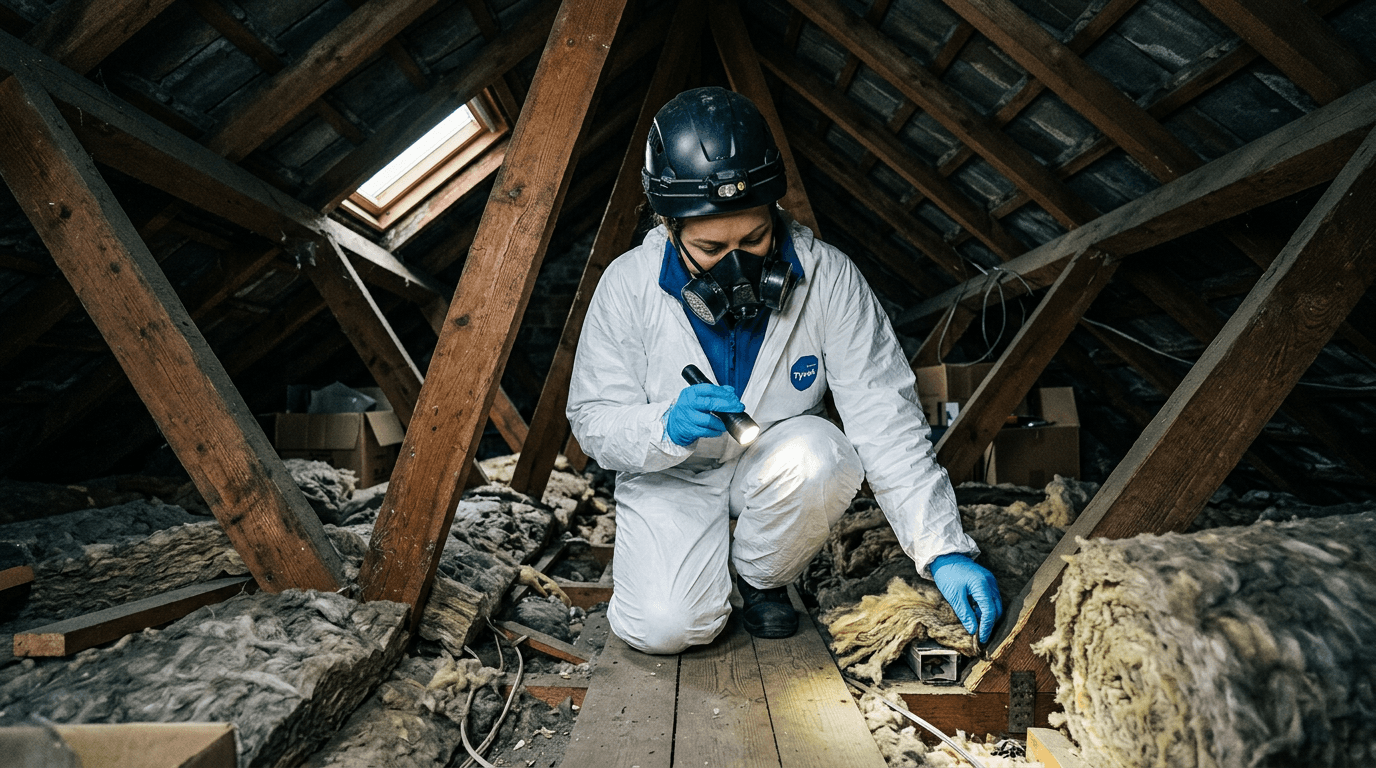
Technician in protective clothing and respirator inspecting a loft with a torch
Illustrative image.
  • Is there evidence of live rodent activity, and has it been dealt with?
  • How much contamination is there, and which materials has it reached?
  • Can surfaces be cleaned, or do porous materials such as insulation need removing?
  • Which areas are food-contact, high-contact or hard to reach?
  • What waste will be produced, and how must it be handled?
  • Who uses the space, and when can they safely return?

Disease guide

Viral and Bacterial Infections Associated with Rodents

Viral and bacterial infections behave differently, so they are kept separate here. This is general information, not medical advice.
ViralA family of viruses carried by rodents

Hantavirus infections

Hantaviruses are a group of viruses carried by rodents. Different hantaviruses are associated with different rodent species and different diseases, so it is not accurate to say that all hantaviruses behave the same way.

Two main illnesses are described. Hantavirus pulmonary syndrome (HPS) mainly affects the lungs and is associated with hantaviruses found in the Americas. Haemorrhagic fever with renal syndrome (HFRS) mainly affects the kidneys and is associated with hantaviruses found in Europe and Asia.

How it spreads

  • Mainly through contact with infected rodent urine, droppings or saliva, including breathing in particles from disturbed contaminated material, depending on the virus.
  • Human-to-human transmission is uncommon for most hantaviruses. It is associated with particular strains, notably Andes virus.

Common symptoms

  • Fever, tiredness and muscle aches
  • Headache, nausea, vomiting or diarrhoea
  • Cough and shortness of breath in HPS
  • Reduced urine output and back or abdominal pain in HFRS

Possible complications

  • Severe breathing difficulty and respiratory failure in HPS
  • Acute kidney injury, sometimes needing dialysis, in HFRS
  • Death in severe cases

Reducing risk

  • Avoid disturbing rodent droppings, urine and nesting material carelessly.
  • Do not dry sweep or vacuum droppings. Use wet-cleaning methods with appropriate protection.
  • Seal entry points and control the rodent activity so contamination does not build up.

Where professional help fits: Where rodent contamination is extensive or in hard-to-reach areas, professional cleaning with suitable protection can reduce the need for householders to disturb it. It does not replace pest control or medical care.

Official source: WHO hantavirus fact sheet (opens in a new tab), World Health Organization. Example case: Fatal HPS in a hotel worker, California.

ViralA hantavirus carried by brown (Norway) rats

Seoul virus

Seoul virus is a hantavirus associated with Norway rats and other brown rats. It can cause haemorrhagic fever with renal syndrome. Pet rats and rat-breeding facilities have been linked to human cases.

The 2024 German infection, published in 2025, is a good example of epidemiological investigation: investigators connected a patient's illness to a breeding facility and found that her own pet rats were negative.

How it spreads

  • Contact with infected rat urine, droppings, saliva or nesting material, including airborne particles in affected environments.

Common symptoms

  • Fever, fatigue and malaise
  • Gastrointestinal symptoms in some patients
  • Low blood pressure in severe illness

Possible complications

  • Kidney-related complications, including acute kidney injury that may need dialysis
  • Mortality is low but not zero

Reducing risk

  • Buy pet rats only from sources that test their animals, and follow public-health advice if a link to an outbreak is reported.
  • Avoid unprotected contact with rodent urine, droppings, saliva and nesting material.
  • Clean contaminated areas using wet methods with suitable protection.

Where professional help fits: Cleaning and disinfection of contaminated surfaces can form part of the response to a confirmed or suspected rat contamination problem, alongside veterinary and public-health advice.

Official source: UKHSA hantavirus explainer (opens in a new tab), UK Health Security Agency. Example case: Seoul virus linked to a breeding facility, Germany.

BacterialCaused by Leptospira bacteria

Leptospirosis

Leptospirosis is caused by Leptospira bacteria carried by a range of animals, including rodents, livestock and dogs. Rodent contamination is relevant but is not the only possible source.

How it spreads

  • Through infected animal urine and contaminated water or soil.
  • Bacteria can enter through mucous membranes (eyes, nose, mouth) or damaged skin.

Common symptoms

  • Fever, headache and chills
  • Muscle pain, particularly in the calves
  • Nausea, vomiting or diarrhoea
  • Red eyes or a rash in some patients

Possible complications

  • Kidney injury or failure
  • Liver involvement and jaundice
  • Meningitis, bleeding or breathing problems in severe disease (Weil's disease)

Reducing risk

  • Cover cuts and wear waterproof gloves when handling potentially contaminated material.
  • Wash hands and exposed skin after contact and avoid touching your face during cleaning.
  • Avoid contact with water or soil likely to be contaminated by animal urine.

Where professional help fits: Where rodent urine has contaminated surfaces, thorough cleaning followed by disinfection with a suitable product can reduce contamination. Rodent control is still needed to stop new contamination.

Official source: UKHSA leptospirosis guidance (opens in a new tab), UK Health Security Agency (GOV.UK). Example case: Leptospirosis in a farmer after a rat infestation, Norfolk.

BacterialCaused mainly by Streptobacillus moniliformis

Rat-bite fever

Rat-bite fever is a bacterial illness caused principally by Streptobacillus moniliformis, a bacterium that rats can carry without appearing ill. Despite the name, infection can follow handling rodents as well as bites.

How it spreads

  • Bites and scratches from infected rodents.
  • Handling infected rodents, and contact with food or water contaminated by the bacteria.

Common symptoms

  • Fever and chills
  • Vomiting and headache
  • Rash and muscle or joint pain

Possible complications

  • Infection of the heart or other organs
  • Sepsis
  • Death can occur, particularly if untreated

Reducing risk

  • Wash bites and scratches promptly and seek medical advice.
  • Wash hands after handling rodents or their bedding.
  • Tell clinicians about rodent contact when you are unwell.

Where professional help fits: A person with suspected rat-bite fever needs medical assessment. Environmental cleaning and disinfection cannot treat the illness and are not a substitute for healthcare.

Official source: CDC MMWR report on fatal rat-bite fever (opens in a new tab), Morbidity and Mortality Weekly Report (CDC). Example case: Fatal rat-bite fever in a child, California.

BacterialCaused by Salmonella bacteria

Salmonellosis

Salmonella bacteria are a common cause of food-related illness. Rodents can contribute to contamination of food and food-contact environments, but contamination by a rodent is a possible source, not a confirmed source of any individual infection.

How it spreads

  • Contaminated food or water and food-contact surfaces
  • Contact with contaminated surfaces followed by touching the mouth

Common symptoms

  • Diarrhoea
  • Fever
  • Abdominal cramps
  • Nausea and vomiting

Possible complications

  • Dehydration
  • Bloodstream infection in vulnerable people
  • More serious illness in infants, older people and those with weakened immunity

Reducing risk

  • Good food hygiene and prompt removal of contaminated food.
  • Cleaning and disinfecting food-contact surfaces appropriately.
  • Preventing rodent access to food storage and preparation areas.

Where professional help fits: In kitchens and food storage areas, documented cleaning and disinfection alongside pest control supports hygiene management. It does not by itself demonstrate compliance with food-safety law.

Official source: HSE biocides guidance (product regulation) (opens in a new tab), Health and Safety Executive.

Documented cases

Real Medical Cases Linked to Rodent-Associated Disease

The nine cases below come from peer-reviewed journals, government public-health reports and the World Health Organization. Each one is summarised without names or identifying details, and each is linked to its original source.

They are included to explain why contamination matters, not to suggest that every infestation causes illness. Where a source does not establish how someone became infected, we say so.

Case 1Viral

Seoul hantavirus linked to a rat-breeding facility, Germany

Disease
Seoul virus infection (hantavirus)
When
Illness in March 2024; published October 2025
Where
Central Germany
Patient
Previously healthy 44-year-old woman

The patient became unwell in March 2024 with fever and fatigue, and developed severe acute kidney injury. Laboratory testing confirmed Seoul hantavirus infection. She needed three haemodialysis sessions and her kidney function later returned to normal.

What the source confirms

  • Seoul hantavirus infection was confirmed by laboratory testing.
  • She had visited a private pet rat breeding facility about five weeks before symptoms began.
  • Virus sequences from rats at the facility closely matched the virus found in the patient.
  • The four pet rats she owned showed no evidence of Seoul virus.

What is probable or presumed

  • The authors judged that infection was probably acquired through aerosols during the facility visit. This is the investigators' interpretation of the evidence, not a directly observed event.

Why it matters

A documented link between an infected rat-breeding environment and human infection. It shows why investigators trace animal and environmental exposure when a patient has unexplained kidney injury.

Limits of this case

Do not generalise this to every rat infestation or every home. It concerns a breeding facility with infected animals.

Source: Seoul virus infection acquired at a private pet rat breeding facility, Germany (opens in a new tab). Emerging Infectious Diseases (CDC), October 2025. Checked 29 October 2026.

Case 2ViralFatal outcome reported

Fatal hantavirus pulmonary syndrome in a hotel worker, California

Disease
Hantavirus pulmonary syndrome
When
5 to 6 March 2025
Where
California, United States
Patient
26-year-old hotel worker

The worker developed flu-like symptoms including fever, cough, nausea and diarrhoea. He attended an emergency department on 5 March and returned the next day after deteriorating. He died on 6 March. Post-mortem testing confirmed hantavirus pulmonary syndrome.

What the source confirms

  • Post-mortem testing confirmed hantavirus pulmonary syndrome.
  • The California FACE investigation identified likely workplace exposure to airborne particles associated with deer-mouse droppings.
  • The investigation highlighted gaps in worker training and disease-prevention procedures.

What is probable or presumed

  • The exposure was described as likely. The report does not establish a specific room or task as the proven source.

Why it matters

Relevant to workplace risk assessment, rodent contamination, staff training and safe handling of rodent waste. Staff who clean or enter affected areas need to know what to avoid and what protection to use.

Limits of this case

This does not show that the whole hotel was infected, and it does not suggest that fogging alone would have prevented the death.

Source: California FACE investigation 25CA004: hotel worker fatality from hantavirus pulmonary syndrome (opens in a new tab). California Department of Public Health, Fatality Assessment and Control Evaluation (FACE) programme, 2025. Checked 29 October 2026.

Case 3Bacterial

Severe leptospirosis in Wales

Disease
Leptospirosis
When
Published 2025
Where
Wales, United Kingdom
Patient
54-year-old man

The published clinical case describes a two-week illness with fever, nausea, muscle pain, diarrhoea and reduced urine output. His condition worsened and he needed intensive care and haemofiltration. Leptospirosis was confirmed by laboratory testing.

What the source confirms

  • The diagnosis was laboratory-confirmed leptospirosis.
  • He needed intensive care and haemofiltration.

Why it matters

Severe leptospirosis can occur in the UK and may at first resemble other illnesses, so a history of possible animal or water exposure matters to clinicians.

Limits of this case

This is not a proven case of infection from a rat-infested building. The source does not establish that route of transmission.

Source: Severe leptospirosis case report, Wales (opens in a new tab). Peer-reviewed clinical case report (PubMed Central), 2025. Checked 29 October 2026.

Case 4Viral

Hantavirus in East Yorkshire

Disease
Hantavirus infection
When
Published 2014
Where
East Yorkshire, England
Patient
59-year-old man

The patient developed a febrile illness with acute kidney injury. Leptospirosis was first suspected because of farm exposure, but further testing identified hantavirus. Investigators found the same hantavirus serotype in rats captured on his property. He recovered.

What the source confirms

  • Further testing identified hantavirus infection.
  • The same serotype was found in rats captured on the patient's property.
  • He recovered.

Why it matters

Shows the diagnostic challenge when two rodent-associated infections look similar, and why animal and environmental exposures are worth investigating.

Limits of this case

One patient. It illustrates a diagnostic pathway and does not measure how common such infections are.

Source: Hantavirus infection in East Yorkshire, England (opens in a new tab). Peer-reviewed clinical case report (PubMed Central), 2014. Checked 29 October 2026.

Case 5BacterialFatal outcome reported

Fatal rat-bite fever in a child, California

Disease
Rat-bite fever (Streptobacillus moniliformis)
When
August 2013 (reported 2014)
Where
San Diego County, California, United States
Patient
Previously healthy 10-year-old boy

The child developed fever, vomiting, headaches and leg pain and died. Post-mortem testing detected Streptobacillus moniliformis, the bacterium responsible for rat-bite fever. The report documented scratches from his pet rats.

What the source confirms

  • Streptobacillus moniliformis DNA was detected in post-mortem tissue.
  • The autopsy noted that he had been scratched by his pet rats.
  • One of his two pet rats also tested positive for the bacterium.

Why it matters

This is a bacterial infection, not a viral one. Pet rodents can also carry organisms associated with human disease, and a person with this kind of illness needs medical assessment, not environmental disinfection alone.

Limits of this case

A pet-rat exposure. It is not a case of building contamination.

Source: Notes from the Field: Fatal Rat-Bite Fever in a Child, San Diego County, California, 2013 (opens in a new tab). Morbidity and Mortality Weekly Report (CDC), 2014. Checked 29 October 2026.

Case 6Viral

Seoul virus infections associated with pet rats, Tennessee

Disease
Seoul virus infection (hantavirus)
When
December 2016 to April 2017 (published October 2017)
Where
Tennessee, United States
Patient
38-year-old woman (one of two household cases)

The CDC reported human Seoul virus infections linked to pet rats. One patient, a 38-year-old woman, developed high fever, loss of appetite, fatigue and shortness of breath. She tested positive for Seoul virus and recalled cleaning rodent droppings from a bathtub about three weeks before becoming ill.

What the source confirms

  • Her blood tested positive for Seoul virus antibodies and Seoul virus RNA.
  • Her daughter, who owned the pet rats, had earlier been infected.
  • Public-health officials advised the family on avoiding contact with rodent urine, droppings, saliva and nesting materials.

What is probable or presumed

  • The remembered cleaning of droppings is relevant to the investigation, but it does not independently prove the exact route of transmission.

Why it matters

Households with infected pet rodents face ongoing exposure risk, and cleaning droppings without precautions is a recognised concern.

Limits of this case

Part of a pet-rat outbreak investigation. It does not describe ordinary pest infestations.

Source: Notes from the Field: Multiple Cases of Seoul Virus Infection in a Household with Infected Pet Rats, Tennessee, December 2016 to April 2017 (opens in a new tab). Morbidity and Mortality Weekly Report (CDC), 13 October 2017. Checked 29 October 2026.

Case 7Bacterial

Leptospirosis in a farmer after a reported rat infestation, Norfolk

Disease
Leptospirosis
When
Published 2014
Where
Norfolk, England
Patient
73-year-old man

The report describes a farmer with a recent rat infestation who developed severe illness, including abdominal pain, diarrhoea, coughing blood and muscle pain. Tests confirmed leptospirosis. He needed haemofiltration and recovered.

What the source confirms

  • Leptospirosis was confirmed by testing.
  • He required haemofiltration and recovered.

What is probable or presumed

  • The rat infestation formed part of his exposure history. The report does not conclude that it was the only source of infection.

Why it matters

A reported rodent infestation is a relevant exposure to tell clinicians about when someone is seriously ill.

Limits of this case

Do not read this as proof that the infestation caused the illness.

Source: Leptospirosis in a farmer after a rat infestation, Norfolk, England (BMJ Case Reports) (opens in a new tab). BMJ Case Reports (PubMed Central copy), 2014. Checked 29 October 2026.

Case 8Viral

Haemorrhagic fever with renal syndrome in northern Greece

Disease
Haemorrhagic fever with renal syndrome (hantavirus)
When
June 1984
Where
Northern Greece
Patient
Two woodcutters

Researchers described two woodcutters diagnosed with haemorrhagic fever with renal syndrome after presumed exposure to wild rodents and their urine in a forest. Both developed acute kidney problems and one needed haemodialysis. Both recovered without lasting complications reported in the study.

What the source confirms

  • Both men were diagnosed with haemorrhagic fever with renal syndrome.
  • One required haemodialysis; both recovered.

What is probable or presumed

  • Exposure to wild rodents and their urine in the forest was presumed.

Why it matters

Rodent-associated disease has been documented in Europe and is not limited to tropical countries or North America.

Limits of this case

A forest setting, not a building, and an older report. It is included for geographic context only.

Source: Haemorrhagic fever with renal syndrome in northern Greece (opens in a new tab). The Journal of Infectious Diseases (PubMed record), June 1984. Checked 29 October 2026.

Case 9ViralFatal outcome reported

Andes hantavirus outbreak associated with a cruise ship

Disease
Andes hantavirus infection
When
Reported by WHO on 2 July 2026
Where
International; travellers on the MV Hondius
Patient
13 cases, including three deaths

WHO reported 13 cases and three deaths in an Andes hantavirus outbreak associated with people travelling on the MV Hondius. Its report described the outbreak as contained following follow-up of identified contacts.

What the source confirms

  • WHO reported 13 cases including three deaths.
  • WHO described the outbreak as contained after contact follow-up.

Why it matters

Recent international context: Andes virus is the hantavirus most associated with limited person-to-person spread, which is why contact follow-up matters.

Limits of this case

This is not evidence that an ordinary building was contaminated or that property disinfection would have prevented the outbreak. This page does not claim the original source was established.

Source: Disease Outbreak News: Andes hantavirus outbreak associated with the MV Hondius (opens in a new tab). World Health Organization, 2 July 2026. Checked 29 October 2026.

Statistics

What the Official Figures Show

These figures come from the UK Health Security Agency. They describe disease surveillance, not the number of infestations or the cause of any one infection.
  • 115

    leptospirosis cases in England, 2025

    63 confirmed, 52 probable

  • 10 of 32

    cases with exposure data reported rodent exposure

    Exposure is not proof of source

  • 28

    cases reported in London, 2025

    All exposure sources

Leptospirosis cases reported in England, 2021–2025

Confirmed and probable cases, all exposure sources, UK Health Security Agency.

04590135180992021992022139202315620241152025
View the data as a table
Leptospirosis cases reported in England, 2021–2025
YearCases
202199
202299
2023139
2024156
2025115

England recorded 115 confirmed and probable leptospirosis cases in 2025, compared with 156 in 2024. These are surveillance figures for leptospirosis, not a count of infections exclusively caused by rats or acquired inside buildings. Among the 32 cases with exposure information, ten reported rodent exposure. Reported exposure does not establish the source of every infection.

Source: Common animal-associated infections in England: 2025 annual report (opens in a new tab), UK Health Security Agency, 26 March 2026. Checked 29 October 2026. Limitation: Surveillance counts of leptospirosis from all sources. They are not a count of infections caused by rats or acquired in buildings, and they do not measure infestation.

Hantavirus figures: Europe and the Americas

UKHSA quotes regional hantavirus figures from different surveillance systems and different viruses. They are shown separately and must not be added together.

Hantavirus figures reported by the UK Health Security Agency
FigureScopePeriodNote
Just under 1,900 casesEurope, across different hantavirus strains2023Reported by UKHSA. Europe's cases are mostly associated with different strains from those in the Americas.
229 casesEight reporting countries in the Americas2025Reported by UKHSA. A separate surveillance system and different viruses from the European figure, so the two are not added together.
Occasional UK casesUnited Kingdom, Seoul hantavirus associated with pet ratsOccasional, no annual total published in this articleUKHSA describes the risk to the general UK public as very low.

Source: What is hantavirus, how is it transmitted and what are the symptoms? (opens in a new tab), UK Health Security Agency, 5 May 2026.

References

Sources and Evidence

Every case study and statistic on this page is linked to its original source. Links were opened and the quoted details checked on 29 October 2026. Where a source has limits, they are stated.
  1. Seoul virus infection acquired at a private pet rat breeding facility, Germany (opens in a new tab)

    Publisher
    Emerging Infectious Diseases (CDC)
    Published
    October 2025
    Disease
    Seoul virus infection (hantavirus)
    Location
    Central Germany
    Evidence type
    Peer-reviewed journal article
    Checked
    29 October 2026

    Supports: Patient history, clinical course, laboratory confirmation, the link to a pet rat breeding facility, and the finding that the patient's own rats showed no evidence of Seoul virus.

    Limits: A single investigated case. It documents an association with a breeding facility; it does not describe typical risk in an ordinary home.

  2. California FACE investigation 25CA004: hotel worker fatality from hantavirus pulmonary syndrome (opens in a new tab)

    Publisher
    California Department of Public Health, Fatality Assessment and Control Evaluation (FACE) programme
    Published
    2025
    Disease
    Hantavirus pulmonary syndrome
    Location
    California, United States
    Evidence type
    Occupational fatality investigation
    Checked
    29 October 2026

    Supports: Dates of illness and death, post-mortem confirmation, the likely workplace exposure to airborne particles associated with deer-mouse droppings, and the gaps in worker training and prevention procedures.

    Limits: The investigation reports a likely exposure, not a proven location. It does not conclude that the building as a whole was infected.

  3. Severe leptospirosis case report, Wales (opens in a new tab)

    Publisher
    Peer-reviewed clinical case report (PubMed Central)
    Published
    2025
    Disease
    Leptospirosis
    Location
    Wales, United Kingdom
    Evidence type
    Peer-reviewed journal article
    Checked
    29 October 2026

    Supports: Age, sex, symptoms, intensive-care treatment, haemofiltration and laboratory-confirmed diagnosis.

    Limits: The report does not establish the route of transmission and must not be read as a rat-infested-building case.

  4. Hantavirus infection in East Yorkshire, England (opens in a new tab)

    Publisher
    Peer-reviewed clinical case report (PubMed Central)
    Published
    2014
    Disease
    Hantavirus infection
    Location
    East Yorkshire, England
    Evidence type
    Peer-reviewed journal article
    Checked
    29 October 2026

    Supports: Presentation with fever and acute kidney injury, initial suspicion of leptospirosis, identification of hantavirus and the same serotype in rats captured on the patient's property, and recovery.

    Limits: One patient. It illustrates a diagnostic pathway and does not quantify risk.

  5. Notes from the Field: Fatal Rat-Bite Fever in a Child, San Diego County, California, 2013 (opens in a new tab)

    Publisher
    Morbidity and Mortality Weekly Report (CDC)
    Published
    2014
    Disease
    Rat-bite fever (Streptobacillus moniliformis)
    Location
    San Diego County, California, United States
    Evidence type
    Public-health agency report
    Checked
    29 October 2026

    Supports: Patient age and sex, symptoms, post-mortem detection of Streptobacillus moniliformis, scratches from pet rats, and the report's wider case series of 17 cases.

    Limits: A pet-rat exposure, not a building contamination case.

  6. Notes from the Field: Multiple Cases of Seoul Virus Infection in a Household with Infected Pet Rats, Tennessee, December 2016 to April 2017 (opens in a new tab)

    Publisher
    Morbidity and Mortality Weekly Report (CDC)
    Published
    13 October 2017
    Disease
    Seoul virus infection (hantavirus)
    Location
    Tennessee, United States
    Evidence type
    Public-health agency report
    Checked
    29 October 2026

    Supports: Two household cases, the pet-rat link to a wider outbreak, the patient who recalled cleaning rodent droppings from a bathtub, and the public-health response.

    Limits: The recalled cleaning exposure is relevant but does not by itself prove the route of transmission.

  7. Leptospirosis in a farmer after a rat infestation, Norfolk, England (BMJ Case Reports) (opens in a new tab)

    Publisher
    BMJ Case Reports (PubMed Central copy)
    Published
    2014
    Disease
    Leptospirosis
    Location
    Norfolk, England
    Evidence type
    Peer-reviewed journal article
    Checked
    29 October 2026

    Supports: Age, symptoms, laboratory-confirmed leptospirosis, haemofiltration, recovery and the recent rat infestation in the exposure history.

    Limits: The infestation is part of the exposure history; the report does not prove it was the only source of infection.

  8. Haemorrhagic fever with renal syndrome in northern Greece (opens in a new tab)

    Publisher
    The Journal of Infectious Diseases (PubMed record)
    Published
    June 1984
    Disease
    Haemorrhagic fever with renal syndrome (hantavirus)
    Location
    Northern Greece
    Evidence type
    Peer-reviewed journal article
    Checked
    29 October 2026

    Supports: Two woodcutters with presumed exposure to wild rodents in a forest, acute kidney problems, one requiring haemodialysis, and recovery.

    Limits: A 1984 report of two patients in a forest setting; included to show that rodent-associated disease is documented in Europe.

  9. Disease Outbreak News: Andes hantavirus outbreak associated with the MV Hondius (opens in a new tab)

    Publisher
    World Health Organization
    Published
    2 July 2026
    Disease
    Andes hantavirus infection
    Location
    International (travellers on a cruise ship)
    Evidence type
    Public-health agency report
    Checked
    29 October 2026

    Supports: 13 cases including three deaths, and the WHO assessment that the outbreak was contained after follow-up of identified contacts.

    Limits: A travel-associated outbreak. It does not show that an ordinary building was contaminated, and this page does not claim the original source of infection was established.

  10. Common animal-associated infections in England: 2025 annual report (opens in a new tab)

    Publisher
    UK Health Security Agency
    Published
    26 March 2026
    Disease
    Leptospirosis and other animal-associated infections
    Location
    England
    Evidence type
    Government surveillance report
    Checked
    29 October 2026

    Supports: Annual confirmed and probable leptospirosis cases for England, 2021 to 2025, and the 2025 exposure and regional breakdown.

    Limits: Surveillance counts of leptospirosis from all sources. They are not a count of infections caused by rats or acquired in buildings, and they do not measure infestation.

  11. What is hantavirus, how is it transmitted and what are the symptoms? (opens in a new tab)

    Publisher
    UK Health Security Agency
    Published
    5 May 2026
    Disease
    Hantavirus infections
    Location
    Europe, the Americas and the UK
    Evidence type
    Official guidance
    Checked
    29 October 2026

    Supports: Regional hantavirus figures for Europe (2023) and the Americas (2025), occasional UK Seoul virus cases linked to pet rats, and UKHSA's assessment of very low risk to the general UK public.

    Limits: Regional figures come from different surveillance systems and must not be added together.

  12. Hantavirus: fact sheet (opens in a new tab)

    Publisher
    World Health Organization
    Published
    Maintained page
    Disease
    Hantavirus infections
    Location
    Global
    Evidence type
    Official guidance
    Checked
    29 October 2026

    Supports: What hantaviruses are, the difference between HPS and HFRS, transmission routes and the rarity of human-to-human spread (notably Andes virus).

    Limits: A general fact sheet; it does not describe any one case or property.

  13. Leptospirosis: guidance (opens in a new tab)

    Publisher
    UK Health Security Agency (GOV.UK)
    Published
    Maintained page
    Disease
    Leptospirosis
    Location
    United Kingdom
    Evidence type
    Official guidance
    Checked
    29 October 2026

    Supports: Cause, transmission through infected animal urine and contaminated water or soil, symptoms and complications.

    Limits: General guidance; not a diagnosis tool.

  14. Cleaning up after rodents (opens in a new tab)

    Publisher
    Centers for Disease Control and Prevention
    Published
    Maintained page
    Disease
    Rodent-associated disease (general)
    Location
    United States
    Evidence type
    Official guidance
    Checked
    29 October 2026

    Supports: Wet-cleaning principles, why sweeping and vacuuming dry droppings is discouraged, protective precautions and waste handling.

    Limits: US guidance. Its principles are used as recognised public-health practice; UK product use must follow HSE and manufacturer requirements.

  15. Biocides (opens in a new tab)

    Publisher
    Health and Safety Executive
    Published
    Maintained page
    Disease
    Not disease-specific
    Location
    Great Britain
    Evidence type
    Regulator guidance
    Checked
    29 October 2026

    Supports: The UK regulatory framework for biocidal products, including the need for product authorisation before supply and use.

    Limits: Authorisation shows a product may be supplied for its stated uses. It does not prove effectiveness against a named organism in a given setting.

Products Selected for Their Intended Use

At Zeus Services, we use only appropriately approved or authorised products from the relevant regulatory authorities for their intended uses. Products are selected according to the treatment required, the surfaces involved and the applicable instructions for safe and effective application.

Our approach includes following the relevant product instructions, application conditions, required contact times and safety precautions. We do not assume that one product or application method is suitable for every contaminant.

Product authorisation and treatment effectiveness are different things. Authorisation shows a product may be used for its stated purposes under the relevant regulations. Whether it is effective against a particular organism depends on the manufacturer's documentation, the surface, the application method and the contact time. We do not make efficacy claims that the product documentation does not support.

Background on product regulation: HSE biocides guidance (opens in a new tab).

Frequently Asked Questions

What is professional disinfection?

Professional disinfection is a planned process of cleaning and then treating surfaces with a suitable, appropriately authorised disinfectant, following the product instructions, application conditions and contact times. It is scoped to the property, the contamination found and the surfaces involved, rather than being a single treatment for every situation.

What is the difference between cleaning, disinfection and decontamination?

Cleaning removes visible soil and organic matter. Disinfection uses a suitable product on a cleaned surface to reduce the number of microorganisms. Decontamination is the wider process of making an area safe again, which can include removing contaminated material, cleaning, disinfecting and handling waste. They often work together but are not interchangeable.

What diseases can rodents transmit?

Rodents are associated with viral diseases such as hantavirus infections (including Seoul virus) and bacterial diseases such as leptospirosis, rat-bite fever and salmonellosis. Not every rodent carries these organisms and not every infestation leads to illness. Our disease guide above sets out how each is spread and cites official sources.

Can rat urine and droppings spread disease?

They can contribute to exposure. Public-health guidance identifies contact with rodent urine, droppings, saliva and nesting material as relevant to several infections. Whether a particular infestation is a risk depends on whether the animals carry an organism, the amount of contamination and how it is disturbed. Most rodent sightings do not lead to illness, but sensible precautions are advised.

Can rodent contamination affect a loft?

Yes. Lofts contain insulation and stored items that absorb urine and hold droppings and nesting material, and they are hard to clean thoroughly. The extent of contamination decides whether surface cleaning is enough or whether affected insulation or materials need to be removed.

Should I vacuum rat droppings?

No. Public-health guidance, including the CDC's, advises against sweeping or vacuuming dry droppings because it can put particles into the air. Instead, wear suitable protection, wet the area with an appropriate disinfectant solution, follow the product's contact time, then wipe up and bag the waste. For larger or hard-to-reach contamination, professional help is sensible.

Is fogging sufficient to disinfect a property?

Not on its own. Fogging is an application method, not a universal disinfection solution. Droppings, urine and nesting material usually need to be physically removed and surfaces cleaned first, and fogging does not replace pest control, proofing or removal of contaminated materials. Whether it is suitable depends on the product's documentation, the space and the risk assessment.

Are all disinfectants effective against viruses?

No. Disinfectants are authorised for particular uses, and a product that works against some organisms may not be supported for others. Effectiveness claims must be backed by the manufacturer's documentation and the relevant authorisation, and depend on correct dilution, application and contact time.

Does disinfection remove the need for pest control?

No. Disinfection deals with contamination that has already happened. If rodents can still get in, new contamination will follow. Pest control addresses the animals and proofing addresses how they enter, so the three are best considered together.

When should contaminated insulation be removed?

Insulation that has absorbed urine or is heavily soiled with droppings and nesting material generally cannot be cleaned effectively and may need removal and safe disposal. The decision depends on how much material is affected, what type it is and what the assessment finds. We assess the actual site conditions and explain what we recommend and why.

Do you use approved or authorised disinfectant products?

Yes. Zeus Services uses only appropriately approved or authorised products from the relevant regulatory authorities for their intended uses. We select products according to the treatment required and the surfaces involved, and follow the product instructions, application conditions, contact times and safety precautions. Authorisation and efficacy are separate questions, so we do not claim a product kills a specific organism unless the product documentation supports it.

What happens during a professional disinfection assessment?

We look at the property, the contamination found, the surfaces and materials involved and any access or safety issues. We then explain what work is appropriate, whether cleaning, disinfection, waste removal or further remediation is needed, and whether pest control or proofing is also required. The scope is written down so you know what is and is not included.

Can businesses request commercial disinfection?

Yes. We work with hotels, offices, landlords, letting agents and property and facilities managers. Requirements depend on the premises and the contaminants, so we start with a site assessment and agree a clear scope and the documentation you need.

Does every rodent infestation require specialist disinfection?

No. Many infestations are dealt with by pest control, proofing and ordinary careful cleaning. Specialist disinfection is worth considering where contamination is widespread, in hard-to-clean areas such as lofts or voids, in food or hospitality settings, or where a documented scope of work is needed.

Can a disinfection treatment guarantee that no one will become ill?

No. Disinfection can reduce contamination on treated surfaces but it cannot guarantee that nobody will become ill, and it cannot treat illness. If you are unwell, seek medical advice and tell the clinician about any rodent exposure.

How do I request a quotation from Zeus Services?

Use our contact page or call us to describe the property and what you have found. We will arrange an assessment where needed and give you a written scope. We do not publish fixed prices for contamination work because the cost depends on the site conditions.

Plain-English guides from our technicians, before you book.

Read all pest control guides

Request a Disinfection Assessment

Tell us about the property and what you have found. We will assess it and give you a written scope of work.

Book online or speak to our London team.